
NC Medicaid CCP 8F Plan of Care Checklist: What ABA Centers Need in 2026

NC Medicaid CCP 8F plan of care checklist by section for ABA centers—initial, revised, and reauth POC after August 2026 policy and clarification updates.
North Carolina Medicaid's NC Medicaid CCP 8F plan of care rules set the bar for how ABA centers document assessment, medical necessity, goals, behavior intervention, and signatures before units are authorized. If your clinical directors still treat the POC as a long narrative in Word, the August 2026 policy amendment and the August 31 clarification are a practical reason to rebuild around section-level completeness instead of last-minute payer rework.
This guide walks section-by-section through the checklist framework ABA operations teams use to align initial, revised, and reauthorization Plans of Care with CCP 8F—without pretending a software checkbox replaces BCBA judgment or guarantees approval.
What is the NC Medicaid CCP 8F plan of care checklist?
The NC Medicaid CCP 8F plan of care checklist is a section-organized review framework—commonly summarized as on the order of 114 discrete items—that maps CCP 8F expectations to concrete POC fields: diagnosis evidence, referral and orders, FBA and BIP content, skill and behavior goals, caregiver involvement, staffing, authorization artifacts, and signature chain. It is a quality and completeness tool for clinicians and intake coordinators, not a substitute for reading the policy or your state's billing guidance.
Why August 2026 matters for your POC process
Policy amended August 1, 2026 refreshed how North Carolina expects ABA Plans of Care to tie assessment data to treatment scope, concurrent services, and reauthorization evidence. Clarification on August 31, 2026 gave Medicaid-facing teams additional context on how reviewers interpret certain documentation gaps—especially around verified member data, POC type labeling, and reconciliation between the authorization request and the signed plan.
Centers that only update a cover page while leaving assessment narratives stale see the same pattern: authorization delays that look like "clinical" denials but trace back to missing section 2.x or 5.x elements. A section-based checklist makes those gaps visible before submission.
Initial, revised, and reauthorization POC types
CCP 8F distinguishes three POC paths that your submission controls must label correctly:
| POC type | When it applies | Operations focus |
|---|---|---|
| Initial | First authorized episode for the member under current referral | Full assessment foundation, baseline goals, caregiver consent chain |
| Revised | Material change mid-episode—hours, goals, settings, or medical necessity | Version control, parent re-signature when required, payer notification |
| Reauthorization | End of authorized period, continued medical necessity | Progress data, goal status, updated FBA or BIP rationale |
Mixing these labels—or submitting a reauth packet with an initial-style narrative—is one of the fastest ways to burn coordinator time. Your Medicaid POC standards overview should mirror these three paths in intake training.
Section 1.x: Submission controls and POC metadata
Section 1.x covers how the plan is identified and reconciled: POC type, effective dates, member identifiers verified against eligibility, rendering provider and location, and consistency between the PDF you upload and the fields on the authorization request. Intake should confirm verified demographics before the BCBA signs, not after the parent portal signature.
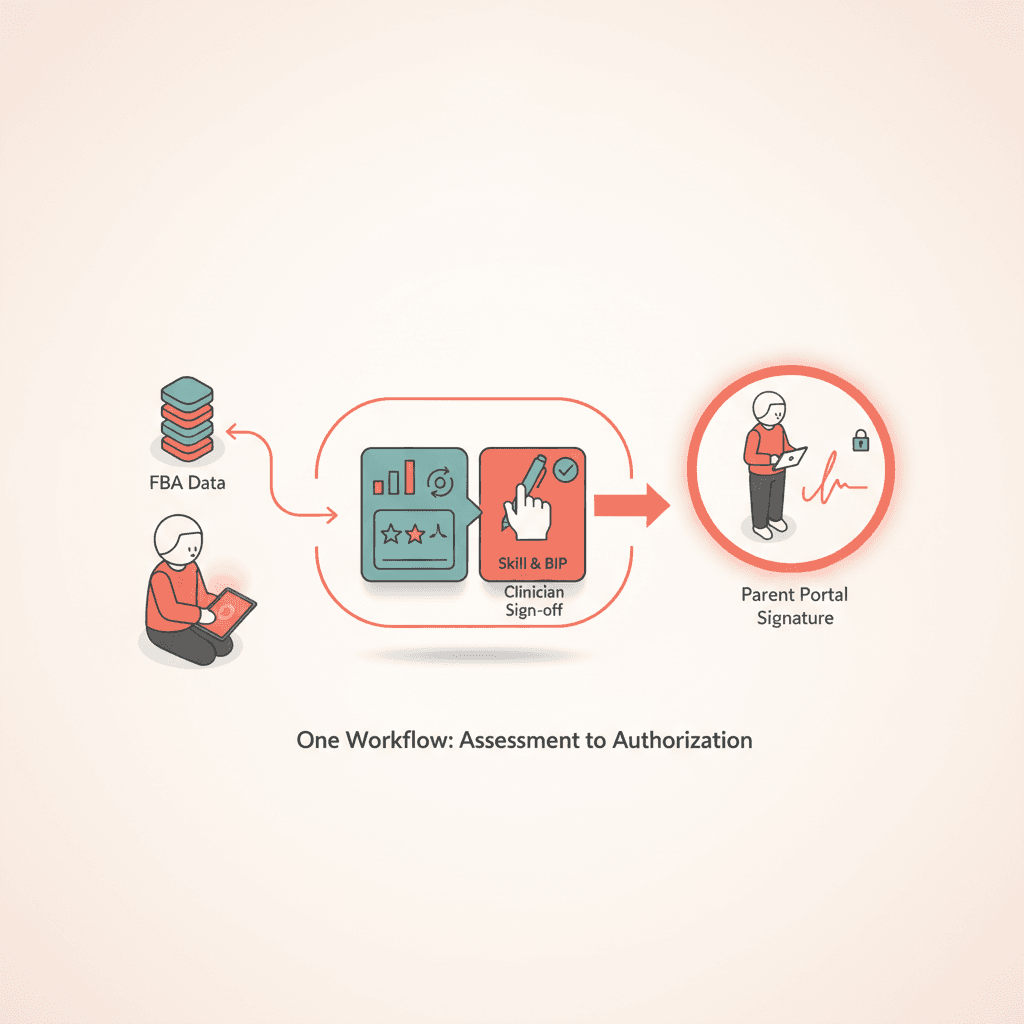
TargetFlo ties POC finalization to the client record so submission metadata and document version stay linked—see Plan of Care and BIP software for how checklist sections surface during drafting.
Section 2.x: Diagnosis and eligibility documentation
Section 2.x expects qualifying autism spectrum disorder documentation aligned to policy—often including structured diagnostic instruments and ICD-10 coding on the POC. ADOS-2 and related assessment reports must be attributable, dated, and consistent with the child assessment narrative.
If your diagnostics team completes ADOS-2 in a separate silo, section 2.x failures show up as "diagnosis not supported" rework. Structured ADOS-2 report workflows that export to the client record reduce copy-paste errors between the diagnostic report and the POC header fields.
Section 3.x: Referral and service order
Section 3.x connects the Medicaid member to physician or qualified practitioner orders and referral documentation. Your intake pipeline should show whether the order date, referring provider, and service type match what the POC claims. Missing or expired orders stall authorization even when clinical content is strong.
Section 4.x: Assessment foundation
Section 4.x captures the broader assessment picture: developmental history, adaptive functioning, record review, and skill inventories such as VB-MAPP or Vineland-3 when policy or your clinical model requires them. This section bridges the child assessment and the measurable goals in section 8.x.
Section 5.x: Functional behavior assessment
Section 5.x requires a defensible FBA summary on the POC: target behaviors, function hypotheses, baseline measurement, and the link to the behavior intervention plan. Vague phrases like "behaviors occur throughout the day" without measurement units fail here more often than in any clinical interview.
Section 6.x: Treatment scope and medical necessity
Section 6.x is the medical necessity narrative: why ABA intensity and setting are appropriate, risks of untreated symptoms, and alignment between recommended hours and assessment severity. BCBAs should write this section for a payer reader, not only for parents.
Section 7.x: Schedule and concurrent services
Section 7.x documents recommended weekly schedule, concurrent therapies, and coordination expectations. Operations leaders use this section to sanity-check whether scheduling capacity matches the POC before authorization—not after enrollment.
Section 8.x: Skill acquisition goals
Section 8.x expects measurable skill goals with baselines, mastery criteria, and estimated timelines. Tables beat prose for reviewers. Each goal should trace to assessment data in section 4.x.
Section 9.x: Behavior reduction and BIP
Section 9.x covers behavior reduction targets, replacement behaviors, proactive and reactive strategies, and data collection plans—the operational heart of the BIP inside the POC. Inconsistent naming between FBA targets and BIP rows triggers avoidable questions.
Section 10.x: Caregivers, consent, and signatures
Section 10.x includes caregiver training commitments, consent artifacts, and the signature chain—clinician first, then guardian attestation where required. Digital parent signature workflows help timestamp and version signed POCs for this section.
Section 11.x and beyond: Staffing, authorization, data, discharge
Sections 11.x+ address supervising BCBA credentials, treatment team roles, authorization request attachments, progress monitoring plans, graphs or data summaries where required, and discharge criteria. Authorization coordinators should confirm that employee credentials on the POC match who is actually scheduled.
How to run checklist reviews without burning out BCBAs
Assign section owners: diagnostics owns 2.x and 4.x inputs, the authoring BCBA owns 5.x–9.x, intake owns 3.x and 11.x packaging, and a compliance lead spot-checks 1.x and 10.x before upload. Weekly POC QA huddles that use section IDs—not generic "looks good"—cut resubmissions.
Software should expose section completeness without auto-filing payers. AI assist may suggest narrative drafts, but licensed clinicians review, edit, and sign every plan. TargetFlo maps checklist sections to clinical documentation fields so gaps are visible before signature.
Book a demo
If your center is rebuilding POC templates after the August 2026 CCP 8F updates, walk through section-level checklist support on a live client record. Book a Demo to see initial, revised, and reauthorization paths in one intake pipeline.
Educational content only; not legal or billing advice. Confirm NC Medicaid CCP 8F requirements and submission formats with your compliance advisor and NC Medicaid resources.
- NC Medicaid CCP 8F plan of care
- Medicaid POC ABA
- ABA plan of care software
- CCP 8F checklist
See it in TargetFlo
Move intake out of the fax inbox
Book a 30-minute demo and we’ll map your referral flow to the 9-stage pipeline, connect your fax provider, and show eligibility checks at intake.
Book a DemoFAQ