

Medicare ABA Treatment Plan Documentation: Orders, Goals, and Medical Necessity
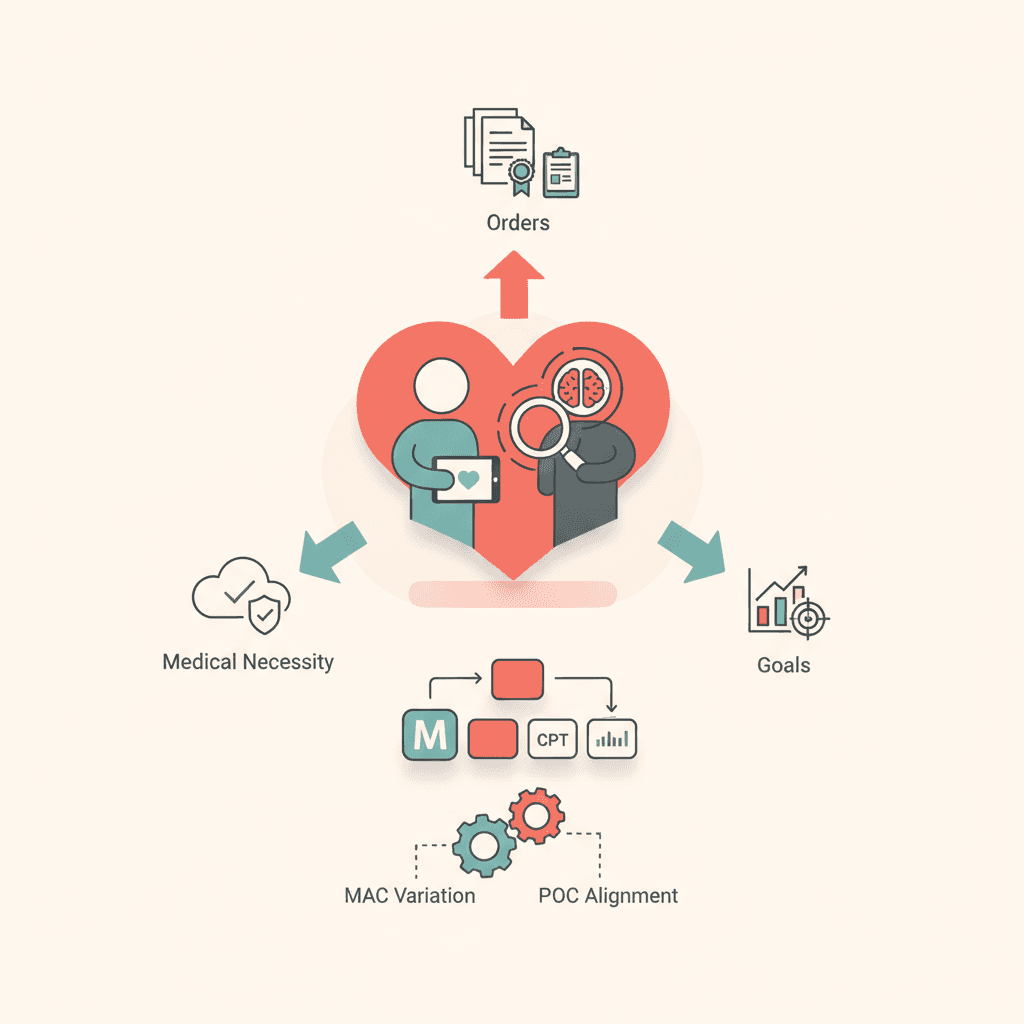
Medicare ABA treatment plan documentation ties orders, medical necessity, and measurable goals to CPT 97151–97158. MAC variation and POC alignment explained.
Medicare ABA Treatment Plan Documentation: Orders, Goals, and Medical Necessity
Medicare ABA treatment plan documentation is the bridge between a qualifying autism diagnosis, the services you propose, and the units a Medicare Administrative Contractor will consider for payment. Centers that treat Medicare beneficiaries need the same discipline they apply to Medicaid Plan of Care packets: every section should answer a reviewer question before it is asked.
This guide walks through orders, medical necessity language, measurable goals, and how CPT 97151 through 97158 should read on the page—not as billing trivia, but as the structural spine of the plan. Rules vary by MAC and state benefit design; treat local policy as authoritative and use this article as operational education only.
Start with the order and the benefit context
Medicare ABA coverage is not uniform nationwide. Some beneficiaries receive services under a defined autism benefit; others may have limited or no ABA coverage depending on policy and setting. Before your BCBA invests hours in a plan, confirm with your billing lead:
- Whether the beneficiary has an active Medicare benefit that includes ABA
- Which MAC processes claims for that jurisdiction
- Whether a specific physician order format or recertification interval applies
The treatment plan should reference the ordering provider, order date, and diagnosis codes that support medical necessity. If your center maintains a dedicated Medicare ABA documentation checklist, use it at intake so the clinical team does not finalize goals against an expired or incomplete order.
Medical necessity: connect diagnosis to proposed services
Medical necessity is not a paragraph you paste from last month. Reviewers look for a logical chain: qualifying diagnosis, functional impact, why ABA is appropriate, why the proposed intensity and setting are reasonable, and what happens if services are not provided.
Strong narratives name the domains you assessed—communication, social reciprocity, restrictive patterns, safety, adaptive skills—and tie each proposed service type to deficits documented in assessment. Avoid vague statements like "patient needs ABA." Instead, describe measurable skill gaps, risk factors, and how the recommended protocol addresses them.
TargetFlo’s clinical workflow keeps assessment summaries, diagnostic reports, and Plan of Care sections on one client record so authors do not re-type history across documents. That consistency helps internal QA; it does not by itself satisfy every MAC edit.
Measurable goals and data collection plans
Medicare reviewers expect the same rigor commercial payers demand: baseline, measurable goal, mastery criteria, generalization plan, and who collects data. Each goal should map to a skill domain and, where applicable, to the service categories in the authorization request.
| Plan element | What reviewers often scrutinize |
|---|---|
| Baseline | Current level with date and method |
| Goal statement | Observable, measurable behavior |
| Mastery criteria | Percent correct, duration, or frequency |
| Service linkage | Which code category supports progress on this goal |
| Caregiver role | Training targets that support maintenance |
When goals live inside the same structured Plan of Care your team uses for Medicaid packets, reauthorization updates become diffs rather than full rewrites. Document version history matters when a MAC asks which plan was in effect on a date of service.
Mapping the plan to CPT 97151–97158
The treatment plan should justify hours by service type, not only by total weekly units. Typical ABA code families include:
| Code range | Service type (plain language) |
|---|---|
| 97151 | Behavior identification assessment |
| 97152 | Supporting assessment |
| 97153 | Adaptive behavior treatment by protocol |
| 97154 | Group adaptive behavior treatment |
| 97155 | Protocol modification |
| 97156 | Family adaptive behavior treatment guidance |
| 97157 | Multiple-family group guidance |
| 97158 | Group adaptive behavior treatment with multiple patients |
Your narrative should explain why each proposed category is medically necessary for this beneficiary. If the plan lists direct treatment hours but omits caregiver training despite significant home-generalization needs, internal reviewers and external auditors may flag the mismatch before the MAC does.
Align planned hours with your center’s billing team’s submission templates. Clinical authors should not guess at unit ceilings; they should document recommended care and let billing translate that into authorized codes under current policy.
MAC and state variation: document the source of truth
Medicare Administrative Contractors publish local coverage articles, billing guides, and edit patterns that change over time. Assign someone on the operations or billing team to track MAC communications and feed summaries to clinical leadership—not to write the plan for the BCBA, but to flag when a required attestation or reassessment interval changed.
State Medicaid rules do not govern Medicare, but many centers serve mixed payer panels. Keep Medicare-specific plan templates separate from Medicaid POC standards content so authors do not accidentally import the wrong signature block or diagnostic attachment list.
Signatures, dates, and version control
Treatment plans fail operationally for mundane reasons: wrong date on the order, parent signature on an outdated version, or BCBA credentials missing from the attestation page. Your workflow should enforce:
- Clinician signature on the finalized clinical plan
- Parent or guardian acknowledgment when policy requires it
- Immutable storage of the signed PDF or structured record
- Clear labeling when a revision supersedes an earlier version
Digital signing through a parent portal reduces mail delays; it does not remove the need for clinical accuracy on the underlying content.
Internal QA before submission
Build a short pre-submission checklist: order valid, diagnosis codes match assessment, goals measurable, hours tied to service types, caregiver training addressed, signatures complete, and assessment dates within policy windows. Run the checklist in the same system where the plan is authored so completion is auditable.
TargetFlo supports structured clinical documentation and POC stages inside the intake pipeline. Teams still own medical necessity judgments and payer-specific formatting.
Book a Demo
See how assessment, Plan of Care, and authorization stages connect on one record. Book a Demo to walk through Medicare-aligned documentation workflows with our team.
Disclaimer
Educational content only; not legal or billing advice. Confirm Medicare coverage, coding, and documentation requirements with your MAC, compliance counsel, and billing specialists before relying on any summary here.
- Medicare ABA
- treatment plan
- medical necessity
- CPT 97151
- Plan of Care
See it in TargetFlo
Move intake out of the fax inbox
Book a 30-minute demo and we’ll map your referral flow to the 9-stage pipeline, connect your fax provider, and show eligibility checks at intake.
Book a DemoFAQ