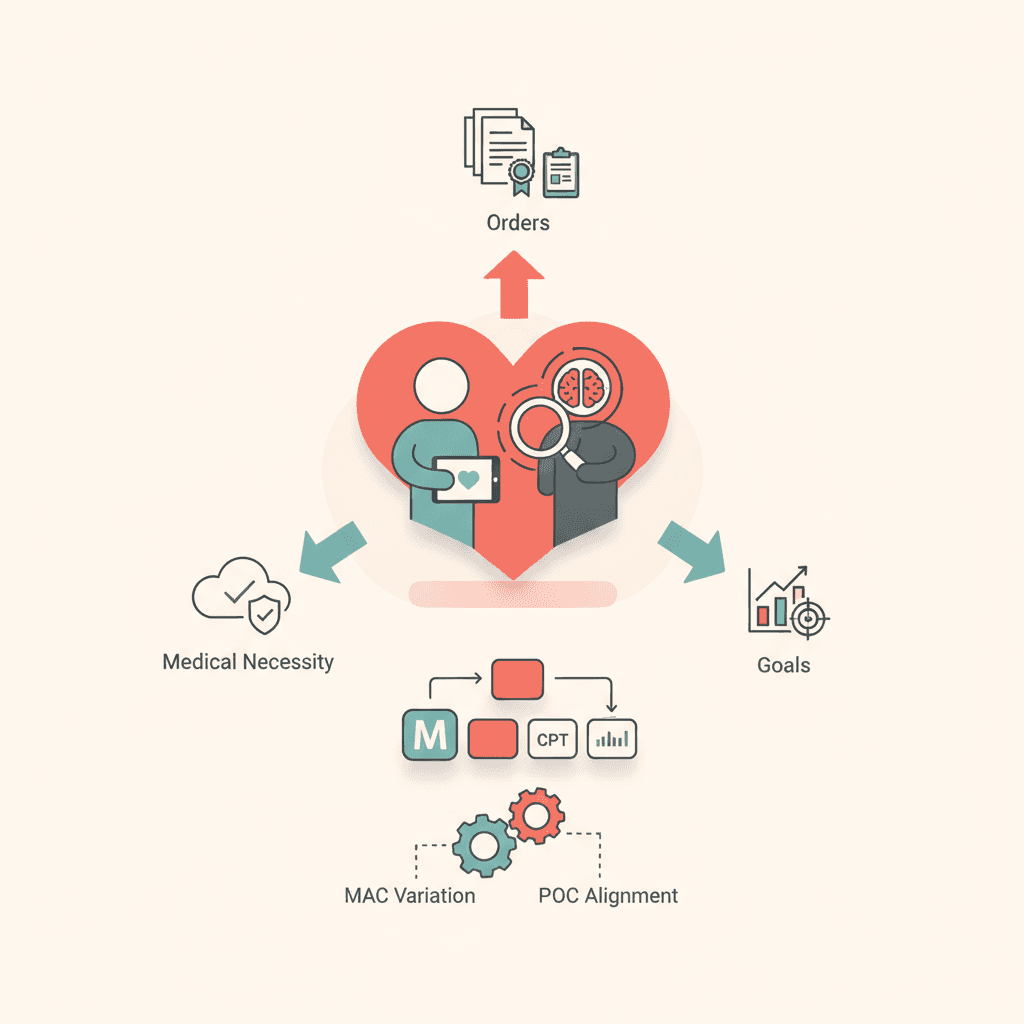

How Structured POC Checklists Help Reduce ABA Authorization Delays

ABA POC authorization delays often trace to missing sections. Structured checklists improve completeness without guaranteeing payer approval—metrics that matter.
How Structured POC Checklists Help Reduce ABA Authorization Delays
ABA POC authorization delays frustrate families who already waited through diagnostics and assessment. Operations leaders often describe these delays as payer black boxes. In practice, a large share is traceable: missing parent signature, diagnostic report older than policy allows, hours listed without caregiver training, or goals that do not mirror assessment domains.
Structured checklists attack that share. They do not guarantee approval—no honest vendor promises that—but they shorten the ping-pong between billing and clinical teams when packets return for fixable gaps.
Completeness versus guaranteed approval
Treat these as separate metrics:
| Metric | What it measures |
|---|---|
| Checklist completion | Required sections present and signed |
| Clinical adequacy | BCBA judgment on goals and necessity |
| Payer decision | Authorized, pended, or denied |
Software excels at the first. Your clinical leadership owns the second. Payers own the third. TargetFlo aligns workflow to completeness tracking inside the intake pipeline and structured Plan of Care records; authorization outcomes remain external.
Build checklists from real deficiency data
Export the last twenty pended or returned POCs from billing—reason codes only if PHI allows aggregate review. Cluster reasons:
- Signature and date issues
- Diagnostic attachment problems
- Hour and code mismatches
- Missing caregiver training or discharge criteria
- Outdated templates after policy change
Each cluster becomes a checklist item with an owner role: BCBA, coordinator, billing, parent via portal.
Map checklist items to pipeline stages
Do not wait until Pending Authorization to discover a missing ADOS attachment. Place requirements on the Diagnostics, FBA, and POC stages so cards cannot advance without overrides logged.
Example stage gates:
- Diagnostics: qualifying report linked, dates within window
- FBA: summary linked to BIP targets
- POC: goals measurable, hours tied to service types, clinician signed
- Parent: parent signatures captured on current version
- Billing: alignment with Medicaid POC standards template for that program
Overrides should require a named reason for audit—not silent clicks.
Reauthorization checklists differ from initial POC
Reauthorizations often need progress summaries, updated baselines, revised hours, and attestation that services remain medically necessary. Clone a separate checklist rather than reusing initial POC items verbatim. Teams forget progress data more often than they forget signatures on first authorization.
Publish a internal one-pager: “Initial vs reauth required attachments by payer.” Software templates can switch by program code on the client record.
Coordinator and BCBA handoffs
Ambiguous ownership creates delay. Define RACI-style rules:
- BCBA completes clinical sections and signs
- Coordinator verifies attachments and parent portal status
- Billing validates codes and submits
- Clinical director reviews exceptions
Tasks generated from incomplete checklist rows beat hallway conversations that evaporate.
Measuring delay reduction honestly
Track median days from POC finalized to authorization submitted, and from submitted to payer decision. If checklist adoption lowers the first interval but not the second, payer capacity or medical necessity scrutiny may dominate—adjust expectations and communications to families accordingly.
Share dashboard views in weekly intake reviews alongside stage aging from intake KPIs.
Parent portal as checklist accelerator
Digital signing removes mail delay but not content errors. Pair portal notifications with checklist rows: “Parent signature pending” should surface on the coordinator dashboard with automatic reminders after defined intervals.
Parents appreciate clarity on what they are signing—link to plain-language summaries where clinical content is dense.
Blog and training loop
When policy changes, update the checklist, publish a short internal note, and reference external education such as state training webinars. Optional: mirror key items in staff LMS courses in TargetFlo Training modules if your center uses them.
This post complements deeper dives on Medicare plans, ADOS documentation, and digital signing—use them as curriculum, not as legal authority.
Template versioning when Medicaid bulletins change
When Medicaid POC standards update, bump checklist version numbers and require staff to acknowledge the diff in training logs. Old cards opened before the cutover date should either migrate to the new template or finish under the old checklist explicitly marked legacy—avoid mixed requirements on one POC.
Escalation paths for repeated payer returns
If the same checklist item fails three submissions across different clients, escalate from coordinator fix to clinical director policy review. The item may be ambiguous, or billing may interpret payer feedback differently from clinical authors. Resolution belongs in a documented standard, not tribal knowledge.
Family communication during pend periods
Checklists reduce internal rework; families still experience wait time. Use portal messages that explain you submitted a complete packet without promising approval dates. Never cite software checklists as proof a payer must authorize—only that your center verified its internal requirements.
Software fields that support checklists
Look for intake software that stores checklist completion per card, logs who checked each row and when, supports payer-specific template sets, and blocks stage advancement unless override reasons are captured. TargetFlo implements stage checklists in the intake pipeline; your center still defines clinical adequacy criteria.
Pair checklists with authorization tracking
After submission, track payer reference numbers, pending reasons, and requested addenda on the same card. When a payer asks for a single missing attachment, update the checklist item that failed—not only the immediate fix—so the next client benefits from the new rule.
Book a Demo
Walk through checklist-driven POC stages, parent signatures, and authorization handoffs on one intake card. Book a Demo.
Disclaimer
Educational content only; not legal or billing advice. Checklists improve operational consistency; they do not replace payer rules or clinical judgment.
- Plan of Care
- authorization
- Medicaid
- intake
- checklist
See it in TargetFlo
Move intake out of the fax inbox
Book a 30-minute demo and we’ll map your referral flow to the 9-stage pipeline, connect your fax provider, and show eligibility checks at intake.
Book a DemoFAQ